It’s 10:47 on a Tuesday night, and Daniel is staring at a slide deck that’s somehow both finished and not at all ready. His board meeting starts in fourteen hours. He’s the managing partner of a twenty-eight-person management consulting firm. He has investors. They want answers. And the QuickBooks exports glowing on his second monitor are giving him exactly none of them.
The numbers are accurate. That’s not the problem. The problem is that “accurate” and “useful” aren’t the same word. A P&L with revenue down 6% from last quarter doesn’t tell anyone why—whether it’s a timing blip, a client churn warning, or the price of saying yes to a strategic project that won’t bill for another sixty days. Daniel knows the answer. The deck doesn’t.
This is the gap most consulting firm owners live with, and it’s the gap that quietly erodes professional reputation one board meeting at a time. So let’s talk about how to close it.
Why Financial Data Isn’t the Same as Stakeholder Communication
Stakeholders—investors, board members, lenders, partners—don’t want a numbers dump. They want three things: Are we on track? What changed? What should we do? Most reporting answers only the first one, and even that gets muddled.
Here’s the uncomfortable truth. A clean monthly close is table stakes. It proves you can count. It doesn’t prove you can lead. When the chair of your board scans your deck looking for the story, what she’s really asking is whether the person presenting the numbers actually understands the business behind them. Confidence travels both ways. If your reports make her work to find the story, she’ll start wondering what else she has to do to find it.
This is where reputation gets built or quietly chipped away. Not in the pitch. In the eleventh slide of a Tuesday morning quarterly update.
What Stakeholder-Ready Reporting Actually Looks Like
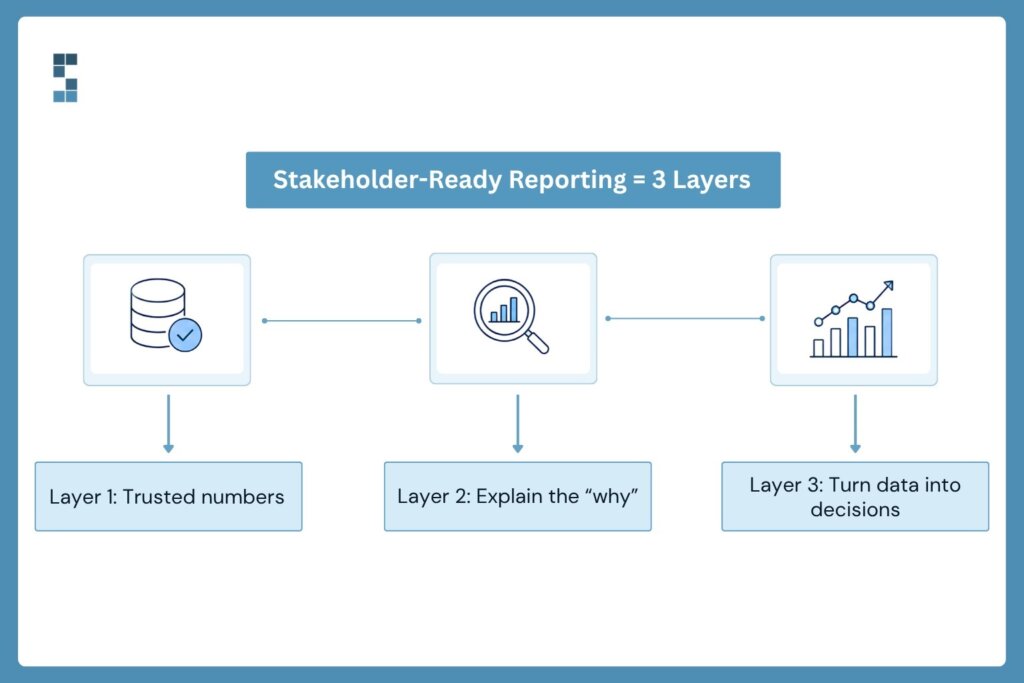
Think of it as three layers.
The first layer is the numbers themselves—accurate, reconciled, on time. This is the foundation, and it’s non-negotiable. Paul, a search-fund operator and System Six client, put it this way: “I have told people that hiring them was the best decision I made at the start of the business. We just finished our 2022 audit, and the auditors found exactly 0 errors by S6.” Zero errors isn’t a flex. It’s the floor. Stakeholders should never have to wonder whether your numbers can be trusted, because the moment they do, every other slide becomes suspect.
The second layer is variance analysis. Why is revenue down 6%? Variance analysis tells the story behind the swing—a delayed implementation, a one-time consulting spike last quarter, a Net-60 payment that landed on the wrong side of month-end. Done well, it also flags what’s actionable versus what’s noise, so your board doesn’t waste a meeting chasing a one-off invoice timing issue when the real conversation should be about pipeline conversion. Stakeholders don’t punish you for variances. They punish you for not seeing them coming, or worse, for being unable to explain them after the fact.
The third layer is the part most firms skip: strategic commentary. A short narrative—three or four sentences—that translates the data into a decision-relevant story. “Margins compressed in Q2 because we onboarded two new associates ahead of the Henderson engagement; utilization normalizes in August.” That’s a sentence a board member can do something with. A P&L isn’t.
Layer those three together, and you stop producing reports. You start producing communication. There’s a difference, and stakeholders feel it before they can name it.
From Defending Numbers to Driving Strategy
Here’s what changes when you walk into a board meeting with a real stakeholder package. The meeting itself shifts. Instead of spending forty minutes defending last quarter, you spend ten minutes summarizing it and thirty minutes planning the next one. Board updates stop feeling like trials and start feeling like working sessions.
That shift compounds. One System Six client, Marcus, captured it well: “I am in good hands with System Six, and I especially appreciate how they are inquisitive, ask follow-up questions, and look around corners.” Looking around corners is the whole game. When your financial reporting is built to surface what’s coming—not just record what already happened—your stakeholders stop reacting to surprises and start funding opportunities. Betsy, another client, framed the emotional side of the same shift: “System Six has done wonders for my stress level to feel like this is all now taken care of with a professional partner.” The stress leaves you as visibility moves into the system.
What does this look like in practice for a consulting firm? Monthly investor updates with a one-page summary, supporting financials, and a forward-looking commentary that names assumptions. Quarterly board packages with variance analysis, KPI trends (utilization, realized rates, pipeline conversion), and the two or three decisions you need from the room. Annual planning packages with scenario modeling so investors can see what success and stress both look like in numbers.
There’s a quieter benefit worth naming. Good investor communication isn’t just about the meetings on the calendar. It’s about the trust that gets built between them. When your monthly update lands in an inbox the same week every month, with the same structure, the same KPIs, and the same honest commentary, you become predictable in the best possible way. Investors who know what to expect from your reporting will give you the benefit of the doubt if one quarter something’s off. Investors who don’t, won’t.
None of this is exotic. It’s just disciplined. And the discipline is what builds the reputation.
Reputation Compounds. Or it erodes.
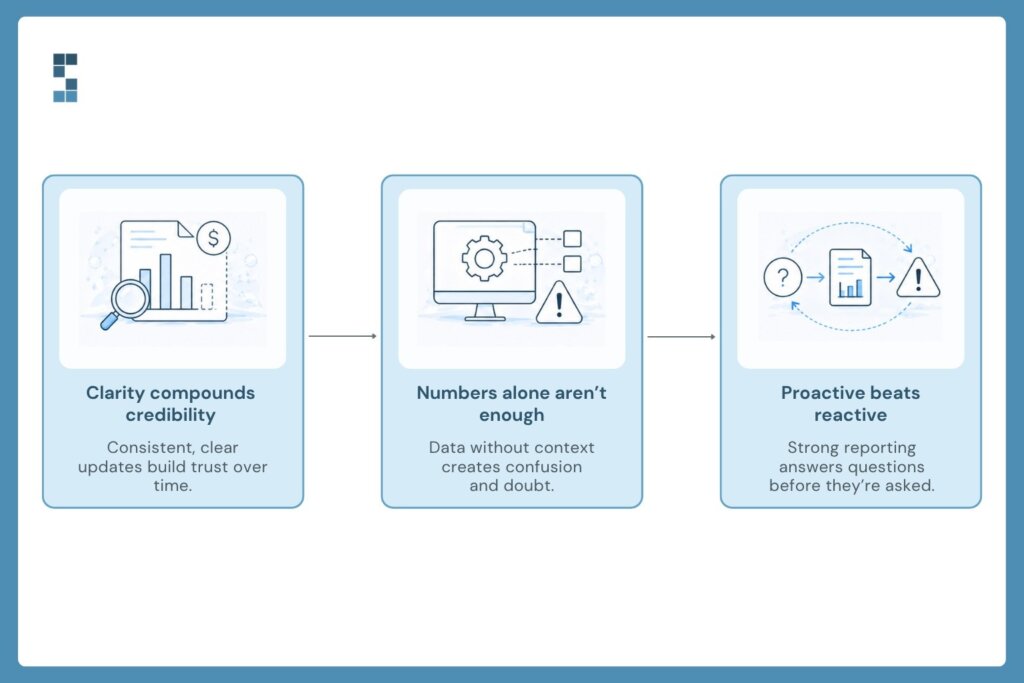
Every clean update is a small deposit in the trust account. Every confused meeting is a small withdrawal. Most firms don’t lose investor confidence after a single disaster. They lost it slowly, across eight or ten board meetings where the numbers were technically right but the story was always missing.
John, a System Six client running an investor-backed business, put a number on what good reporting feels like from the inside: “For any internal NPS or Customer Satisfaction tracking, please mark us down as an 11/10. Your team is awesome, proactive, and exactly what we need.” Proactive. That’s the word stakeholders are quietly grading you on. Are your reports proactive or reactive? Do they surface the question before your board has to ask it?
If you’re already great at this, keep going. If you’re not—and most founders aren’t, because nobody starts a consulting firm to become an accountant—the fix isn’t to work harder on Sunday nights. It’s to build the infrastructure once and let it run. That’s the work System Six does for consulting firms every day: accurate books, variance-ready reporting, board-grade packages, and a team that asks the follow-on questions before your investors do.
So, back to Daniel and his 10:47 PM problem. The deck he was wrestling with wasn’t broken because the numbers were wrong. It was broken because the numbers were alone. Give them company—variance, context, commentary—, and they stop being data. They start being confident.
What would your next board meeting look like if your numbers walked in already telling the story?
About System Six
System Six is a Seattle-based bookkeeping and financial services firm that helps small and mid-sized businesses streamline their financial operations. We specialize in providing technology-driven financial management solutions for consulting firms, enabling owners to focus on growing their businesses without worrying about cash flow, payroll, or compliance. Our team of over 40 professionals brings an average of 10+ years of accounting experience to every client relationship, serving more than 175 businesses across the U.S. With a 9.5/10 NPS score, we deliver the financial clarity and peace of mind that consulting firm owners need to thrive. Learn more at www.systemsix.com.