David stared at his bookkeeping invoice for a long moment. Forty-three hundred dollars. He ran a 14-person management consulting firm, and the business was doing fine, but every month that number nagged at him. Was he paying for someone to keep the lights on? Or was there a real return buried somewhere in those spreadsheets?
Here’s the thing: David wasn’t asking the wrong question. He was calculating the wrong way.
Most consulting firm owners evaluate bookkeeping the same way they’d evaluate a coffee subscription, as a flat monthly cost to be tolerated or negotiated down. But that framing misses almost everything that matters. When you learn to measure the true ROI of your bookkeeping investment, the math tends to look very different from what you expected. Usually better. Sometimes dramatically so.
So let’s do the math. Properly.
Stop Counting What You Pay. Start Counting What You Lose.
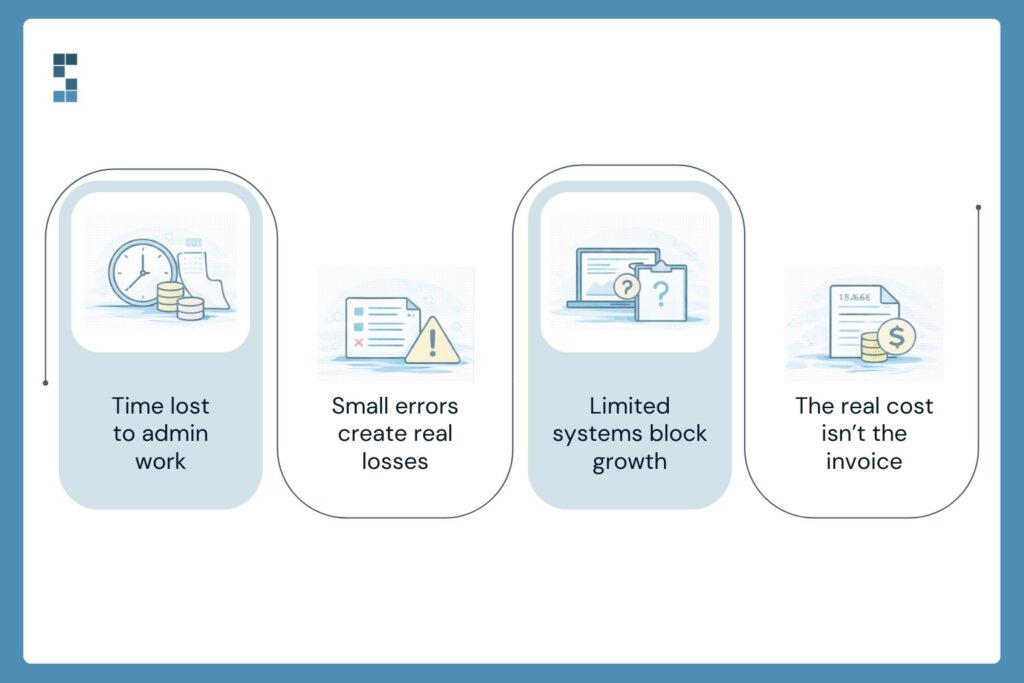
The invoice is the easy number. What’s harder to see — but far more expensive — are the costs hidden beneath your current approach to financial management.
The first hidden cost is time. Take an honest look at how many hours per month you personally spend on financial tasks: reviewing reports, chasing down receipts, reconciling accounts, answering questions from your bookkeeper, and preparing for tax season. Now multiply that by your effective hourly rate. If you’re billing clients at $250 an hour and spending 15 hours a month on financial admin, that’s $3,750 in opportunity cost — every single month. That’s $45,000 a year in time that isn’t going toward client work or business development.
The second hidden cost is errors. They’re sneaky. One System Six client was unknowingly paying $700 a month in unnecessary bank fees because poor cash flow tracking kept triggering overdraft thresholds. That’s $8,400 a year — enough to fund a solid bookkeeping engagement with money left over. The painful part? He had no idea it was happening. You can’t catch what you can’t see.
The third cost is the hardest to quantify but often the most expensive: missed growth opportunities. Consider a consulting firm that gets the chance to take on a $200,000 contract — their biggest ever. The project requires detailed milestone billing, multi-phase budget management, and financial reporting that their existing systems can’t handle. So they pass. That’s not just lost revenue. It’s lost momentum, lost credibility, and a ceiling they didn’t know they’d built for themselves.
Add those three categories together before you start complaining about your bookkeeping bill.
The ROI Formula That Actually Works
True ROI isn’t just about what you pay. It’s about what you gain, what you save, and what you stop losing. Here’s a simple framework with three components.
Component one: direct cost savings. This is time and operational efficiency. When you stop doing manual invoice creation, account reconciliation, and expense categorization yourself, you recover hours — and those hours have a dollar value. Calculate it based on your own rate, not some abstract concept of ‘time saved.’
Component two: risk mitigation value. What’s the cost of the errors and penalties you avoid? A missed payroll tax deadline triggers automatic fines plus interest. A simple bookkeeping error compounds quietly for months. Professional, consistent financial management dramatically reduces the probability of these events.
Component three: growth enablement value. This is the one most firms miss entirely. Better financial infrastructure doesn’t just save time today — it unlocks revenue that wasn’t accessible yesterday.
Here’s what this looks like in practice. A strategy consulting firm was spending 20 hours a month on financial administration. At the owner’s $200 hourly rate, that’s $4,000 a month in opportunity cost. After systematizing their financial processes, that dropped to 3 hours of reviewing automated reports — a $600 monthly time investment. They were paying $800 a month for the service. The math: $3,400 in recovered time, minus $800 in cost, equals a 325% return on investment. And that’s before accounting for the compliance errors they stopped making or the larger clients they could now serve.
The break-even point for a well-designed bookkeeping engagement is typically 2 to 3 months. After that, you’re in positive territory — and the returns compound.
What Good Bookkeeping Actually Unlocks
Numbers are one thing. But the people who’ve lived this tend to describe it differently.
Betsy, a System Six client who runs an investor-backed business, put it this way: “System Six has done wonders for my stress level to feel like this is all now taken care of with a professional partner.” That’s not an accounting outcome. That’s cognitive bandwidth returned — energy quietly consumed by worry, now redirected toward the work that actually matters.
Manish G., another client, was even more direct. After a freelance bookkeeper left his accounts in disarray — payroll taxes filed incorrectly, invoicing halted, operations on the edge of collapse — he turned to System Six. He later wrote: “I can’t begin to describe how thankful I am… they have literally saved my business from falling into operational ruins.” He also noted something that gets to the heart of the ROI question: “I would pay for this expertise without hesitation, given the pricing is so fair for the value.”
That last part is worth sitting with. When the value is real and visible, the cost stops feeling like a cost.
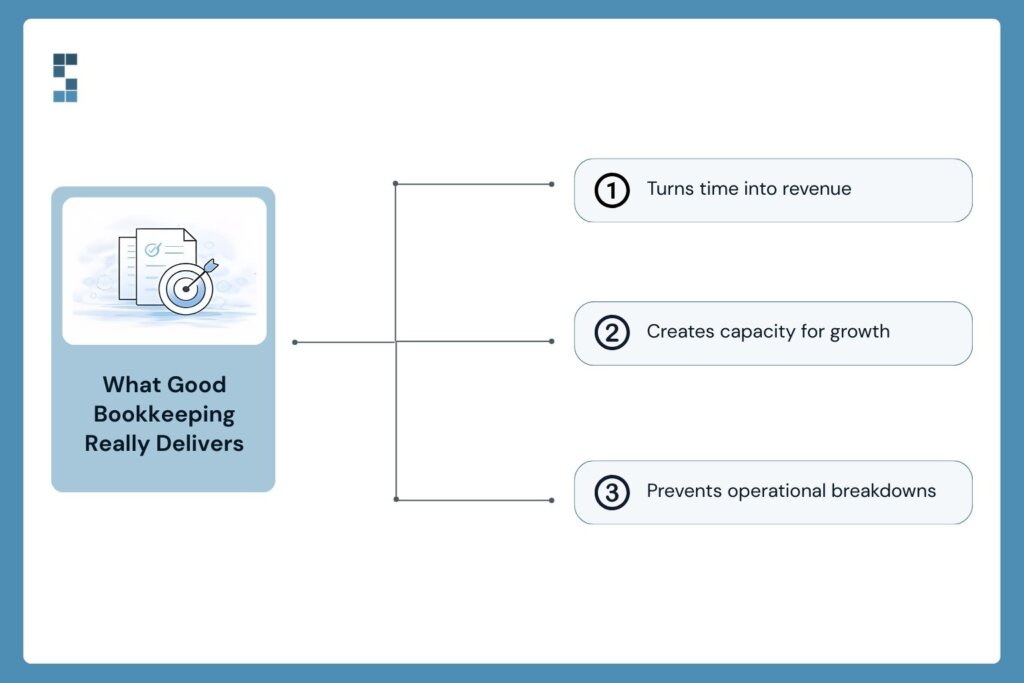
What does that look like in practice for a growing consulting firm? It means you can take on bigger clients because your financial infrastructure can handle the complexity. It means you stop passing on opportunities because your reporting can’t keep up. It means that 15 hours a month you used to spend hunched over QuickBooks becomes 15 hours of business development, strategic thinking, or simply leaving the office before 7 pm.
One extra client meeting per week, made possible by reclaimed time, can translate into tens of thousands of dollars in additional annual revenue. The bookkeeping investment doesn’t just pay for itself — it starts funding growth.
The Only Number That Actually Matters
Here’s the reframe: bookkeeping isn’t a cost center. It’s an investment with a measurable return — one most firms have never actually sat down to calculate.
If you’re paying $800 a month for a service that saves you $3,400 in time, prevents $700 in monthly errors, and positions you to take on clients you couldn’t have handled before, you’re not spending money. You’re multiplying it.
The firms that struggle with this question are usually those that’ve never done an audit. They don’t know how many hours they’re spending. They haven’t added up the bank fees, the penalty notices, the hours their office manager spends chasing down receipts. They’re measuring the invoice and ignoring everything else.
So before you decide whether your bookkeeping investment is worth it, figure out what your financial admin is actually costing you right now. That’s the first number you need. And for most consulting firm owners, it’s the number that changes everything.
What could your firm do with 15 extra hours a month and complete clarity on your cash flow? That’s not a rhetorical question. It’s your ROI calculation waiting to be filled in.
About System Six
System Six is a Seattle-based bookkeeping and financial services firm that helps small and mid-sized businesses streamline their financial operations. We specialize in providing technology-driven financial management solutions for consulting firms, enabling owners to focus on growing their businesses without worrying about cash flow, payroll, or compliance. Our team of over 40 professionals brings an average of 10+ years of accounting experience to every client relationship, serving more than 175 businesses across the U.S. With a 9.5/10 NPS score, we deliver the financial clarity and peace of mind that consulting firm owners need to thrive. Learn more at www.systemsix.com.