
Elena had been talking about automating her books for eight months. She finally pulled the trigger in January, connected her bank feed, and waited. By February, she was still manually correcting misfiled transactions, and her bookkeeper was still spending hours every week cleaning things up. She felt cheated. “Wasn’t this supposed to save time?”
It was. It will. But nobody told Elena that automation implementation isn’t an event — it’s a process. And without a clear picture of what that process actually looks like, many consulting firm owners either give up too early or set themselves up for frustration right out of the gate.
Here’s the honest timeline. No hype, no hand-waving. Just what to expect, week by week, as you transition your financial systems from manual to automated.
Before You Touch a Single Tool: The Assessment Phase (Weeks 1–2)
Everyone wants to skip this part. Don’t.
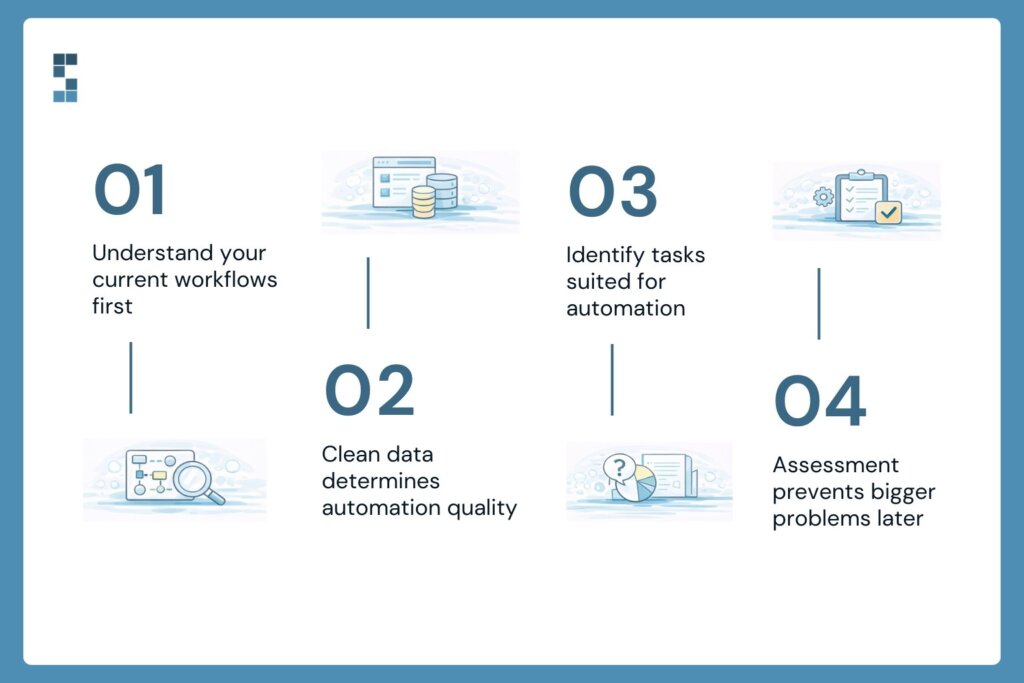
Before any automation implementation can work, you need a clear map of what you’re actually doing right now. Where does your money come from? How do transactions enter your system? What categories do you use, and are they consistent? What software are you already running — QuickBooks, Gusto, a payroll processor, a time tracker?
This isn’t glamorous work. It feels like measuring twice before cutting. But here’s why it matters: automated systems learn from your existing data. If that data is messy — inconsistent categories, duplicate vendors, a chart of accounts that grew organically over five years — the automation inherits the mess. Garbage in, garbage out.
Most consulting firms spend one to two weeks here. You’re documenting your current workflows, identifying which processes are good candidates for automation (hint: anything repetitive and rule-based), and figuring out where the real time drains are. The payoff isn’t immediate, but this phase prevents weeks of backtracking later.
Weeks 1–4: Foundation First
This is when things start to feel real—and when expectations tend to collide with reality.
Bank feeds connect. Categorization rules go in. Payroll integrations link up to your accounting platform. Invoicing workflows get templated. If you’re migrating to a new system entirely, data from the old one starts flowing over.
Expect hiccups. A transaction is assigned to the wrong category. A vendor gets duplicated. A bank feed throws an error because of a password change you forgot about. This is completely normal. The system is learning your business, and so are you. The goal in this phase isn’t perfection — it’s establishing a reliable foundation you can build on.
One thing that makes this phase significantly smoother is expert implementation support. As one System Six client put it: “They take on the entire setup and effectively act as consultants until your accounting operations are running like a well-oiled machine.” That’s the difference between spending four weeks troubleshooting alone and having someone who’s done this for 175+ clients guide you through it.
By the end of week four, your basic financial workflows should be running automatically in the background. You’re not done — but you’re off manual life support.
Weeks 5–12: The System Learns, So Do You
This is the phase nobody talks about, and it’s honestly the most interesting one.
Automation gets smarter as it accumulates transaction history. Categorization accuracy climbs. The system starts recognizing patterns — this vendor always goes to software, that one always goes to travel — and the exceptions you’re manually correcting get fewer every week. Your financial reports are starting to click into place. Real-time dashboards stop feeling like a promise and become a tool.
Your role shifts, too. You move from doing to reviewing. Instead of entering data, you’re checking that the automated system entered it correctly. Instead of building reports, you’re reading them. That’s a fundamentally different relationship with your finances — and a much better use of a consulting firm owner’s time.
There’s a common fear in this phase: “What if I’m doing it wrong?” It’s worth naming directly. The answer is that small errors now are far less costly than the hours you’ve been spending on manual work. If a category is wrong, you fix the rule and move forward. Automation doesn’t demand perfection on day one. It improves incrementally, and so does your confidence with it.
“System Six has done wonders for my stress level,” says Betsy, a System Six client. “I feel like this is all now taken care of with a professional partner.” That feeling — that background hum of financial anxiety going quiet — tends to arrive somewhere in this phase, once the systems have had enough time to prove themselves.
90 Days In: What Your Mornings Look Like Now
Picture a Monday morning three months from now. You open your laptop, pull up your financial dashboard, and spend fifteen minutes reviewing what the system surfaced over the past week. A flagged transaction. An overdue invoice. A cash flow note your bookkeeper left. Then you close the laptop and run your business.
That’s not a fantasy. It’s what properly implemented financial automation actually delivers. Most consulting firms hit a 70–80% reduction in financial management time within ninety days of going live. The hours that used to disappear into receipt sorting, manual reconciliation, and spreadsheet updates get redirected to client work, business development, or — novel concept — not working on weekends.
The math compounds fast. If you’re currently spending fifteen hours a month on financial administration — a conservative estimate for most firms in the $1M–$5M range — that’s 180 hours a year. At a $200 consulting rate, you’re looking at $36,000 in time that could be generating revenue instead of reconciling bank statements.
Paul, a System Six client, put it plainly: “I told people that hiring them was the best decision I made at the start of the business. They’ve crushed it. Not only have they been mistake-free, but they’ve been proactive at catching mistakes I’ve made and seeing challenges coming down the pike.”
That’s the real payoff. Not just time back. Better information, fewer errors, and a financial partner who’s watching your numbers so you don’t have to.
Three Months Is a Short Trade for Years of Time Back

The timeline from start to fully humming automation is roughly ninety days. Two weeks of assessment. Four weeks building the foundation. Six weeks of system learning, and you’re learning with it. That’s it.
Three months can feel like a long time when you’re in the middle of running a consulting firm. But measure it against what comes after: a financial system that runs in the background, books that are always current, and Monday mornings that start with a fifteen-minute review instead of a four-hour catch-up session. Measured that way, ninety days is a very reasonable price.
The firms that make this transition successfully tend to have one thing in common: they don’t try to do it alone. The difference between a smooth automation implementation and a frustrating one almost always comes down to expert setup — someone who knows which pitfalls to avoid, which integrations actually work, and how to configure the system for a consulting firm specifically.
If you’re sitting there wondering what your first step looks like, start with that assessment. Map your current processes. Find out where the time is really going. And if you’d like a partner who’s done this for over 175 consulting firms and counting, System Six would be glad to walk you through it.
About System Six
System Six is a Seattle-based bookkeeping and financial services firm that helps small and mid-sized businesses streamline their financial operations. We specialize in providing technology-driven financial management solutions for consulting firms, enabling owners to focus on growing their businesses without worrying about cash flow, payroll, or compliance. Our team of over 40 professionals brings an average of 10+ years of accounting experience to every client relationship, serving more than 175 businesses across the U.S. With a 9.5/10 NPS score, we deliver the financial clarity and peace of mind that consulting firm owners need to thrive. Learn more at www.systemsix.com.