It’s Tuesday morning. You’re staring at a pile of receipts, three browser tabs showing different bank accounts, and QuickBooks giving you that blank look it always does when you’ve got ten other things to do. Somewhere in the back of your mind, you’re wondering if there’s a better way to handle all this.
And then someone mentions “AI bookkeeping” at a networking event, and suddenly you’re supposed to have an opinion about whether robots should do your books.
Here’s the thing. Everyone’s throwing around “AI” these days like it’s magic dust you sprinkle on problems to make them disappear. Self-driving cars. Chatbots. And now… bookkeeping? It sounds either too good to be true or like the setup for a disaster in which your books are categorized by a computer that thinks your tax payments are office supplies.
So let’s cut through the noise. What does AI actually mean for your bookkeeping? What can it realistically do today? And is it worth switching from whatever system you’re using now—even if that system is mostly you, spreadsheets, and weekend catch-up sessions?
No jargon. No fear-mongering. Just straight talk about what’s real.
What AI Bookkeeping Actually Means
Forget what you’ve seen in sci-fi movies. AI in bookkeeping isn’t a robot sitting at a desk doing your taxes while you sip margaritas on a beach.
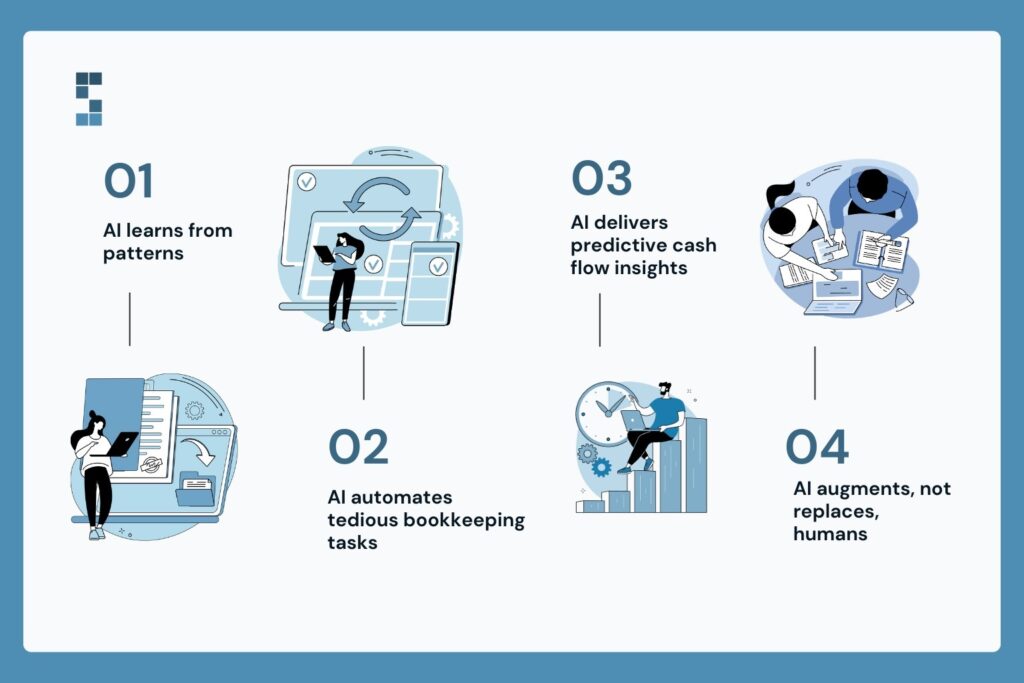
Think of it more like this: Machine learning is pattern recognition that gets smarter over time. You know how you’ve categorized “Staples” as office supplies about 847 times in your accounting system? AI learns that pattern. After seeing it a few times, it starts categorizing Staples automatically. Same with your monthly software subscriptions, your regular vendor payments, and your utility bills. It picks up on the patterns you’ve been teaching it—sometimes without even realizing you were teaching it.
This is different from the old rule-based systems that would break the moment something was slightly off. Remember setting up those rules that worked perfectly until they didn’t? AI adapts. It learns. It gets better the more you use it.
So what does it actually do? The tedious stuff, mostly. Transaction categorization is the big one—taking those hundreds of monthly transactions and putting them in the right buckets without you having to click through each one. Receipt matching and data extraction let you snap a photo of a receipt, and the system automatically pulls out the vendor, amount, and date. Anomaly detection flags weird transactions before they become problems—like when someone accidentally keys in $10,000 instead of $100.00, and you catch it immediately instead of three months later.
And here’s where it gets interesting for consulting firms: predictive cash flow based on your actual patterns. Not generic projections, but insights built from your specific billing cycles, your collection patterns, your seasonal fluctuations. As one System Six client, Alecia, puts it: “I had tears come to my eyes as I was able to see projected cash flow integrated with real-time QuickBooks.”
That’s not hype. That’s relief.
But let’s be honest about what it doesn’t do. AI won’t replace strategic thinking. It can’t handle the nuanced judgment calls involved in complex client billing scenarios. It won’t file your taxes or argue with the IRS on your behalf. You still need human expertise for the decisions that matter.
And you know what? Those limitations don’t matter for about 80% of what’s currently eating your time.
The Real Benefits (And Real Tradeoffs)
Let’s talk about what this actually means for your Tuesday mornings.
Right now, manual transaction categorization probably takes you 10-15 hours a month. Maybe more if you’ve let it pile up. Maybe less if you’re ruthlessly efficient. But it’s still time you’re spending clicking through transactions, making the same categorization decisions over and over, double-checking your work because one mistake can cascade into bigger problems.
Automation reduces that to about two hours of review time. You’re not eliminating the human oversight—you shouldn’t—but you’re changing your role from data entry clerk to quality controller. The math matters here: that’s roughly 96 hours annually you’re getting back. Two and a half work weeks. What could you do with that time? Client development. Strategic planning. Actual consulting work that generates revenue.
The accuracy piece compounds over time. We all make predictable mistakes when doing manual data entry, especially when we’re tired or distracted, or it’s 8 pm on a Friday, and we just want to be done. AI doesn’t get tired. It doesn’t get distracted. It applies the same logic consistently, which means your error rate drops significantly.
One search fund client working with System Six, Paul, mentioned that when his auditors reviewed the books, they found “exactly zero errors.” Zero. That’s not just about avoiding embarrassment—it’s about making better decisions based on data you can actually trust.
And speaking of better decisions: real-time visibility changes everything. You know that cycle where you wait until the weekend to update your spreadsheets, so your cash flow picture is always a week or two behind reality? That ends. You get cash flow visibility when you actually need it—like right now, when you’re deciding whether to hire that next consultant or invest in that new software. Client profitability tracking that’s current, not historical. The ability to see patterns as they’re forming instead of discovering them three months later.
Vincent, another consultant working with System Six, talks about a cash forecasting tool that “significantly improves the speed and accuracy of our forecasting process.” Speed and accuracy. Those two things together transform how you run your business.
But I’d be lying if I said there were no drawbacks. There’s a learning curve. The system needs training initially—you’re teaching it your patterns, your exceptions, your specific business logic. There’s an upfront setup time required to get everything connected and configured correctly. It’s not always cheaper in pure dollar terms, though the ROI comes from getting your time back and making better decisions with current data. And you still need human oversight. Always.
So the question isn’t whether AI is perfect. It’s whether it’s better than what you’re doing now.
What to Look For
If you’re considering making the switch, here’s what actually matters.
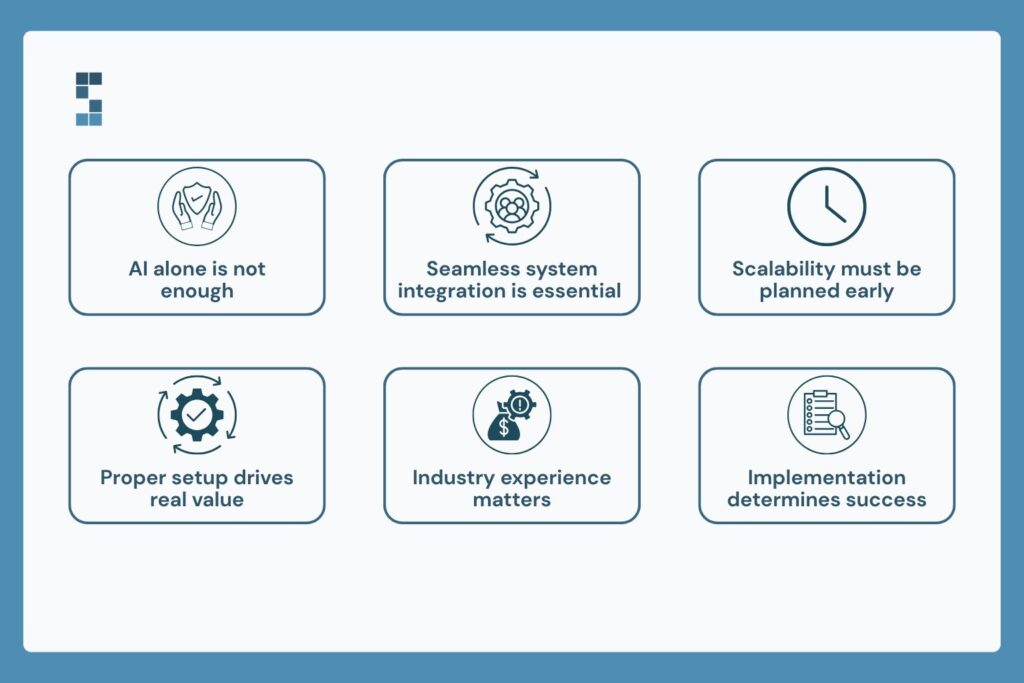
Integration capabilities top the list. The whole point of automation is seamless data flow, which means your AI bookkeeping needs to connect with your existing tools—QuickBooks, your time-tracking system, your business banking, and your expense management app. If you’re still manually exporting from one system and importing to another, you haven’t really automated anything. You’ve just added another step.
But here’s what most people miss: AI is the tool, but expertise is what makes it work. This is where the human element still matters tremendously. A consultant who recently went through a bookkeeping nightmare and then found System Six put it this way: “They’re EXPERTS in their field and work to streamline and automate your end-to-end accounting operations. They take on the entire setup and effectively act as consultants until your accounting operations are running like a well-oiled machine.”
That matters because proper setup requires understanding consulting industry best practices, knowing which metrics actually drive decisions in your business, and configuring the systems to capture the correct information in the right way. System Six’s team brings an average of 10+ years of accounting experience to every client relationship. That expertise transforms generic software into a strategic asset.
Scalability is the other piece that’s easy to overlook when you’re focused on solving today’s problems. Will the system grow with you from fifteen employees to fifty? Can it handle multi-state operations if you expand? Does the pricing model make sense for your size and growth trajectory? You don’t want to implement something that works great now but becomes a constraint eighteen months from now when you’re trying to scale.
The technology matters. But implementation is everything.
The Bottom Line for Consulting Firms
Here’s what this comes down to for your firm.
AI bookkeeping won’t run your business. It’s not going to make strategic decisions, build client relationships, or deliver consulting expertise. But it will give you back your nights and weekends. It’ll give you the ability to make better decisions based on current data instead of week-old spreadsheets. It’ll let you focus your energy on what you’re actually good at—consulting—instead of categorizing transactions.
Marcus, who runs an investor-backed consulting business, says working with System Six makes him feel like he’s “in good hands” and he especially appreciates “how they are inquisitive, ask follow-on questions, and look around corners.” That’s what you want from your financial operations: systems and people who see around corners for you, who catch problems before they become crises, who give you confidence instead of anxiety.
So here’s the question that should guide your decision: What could your firm do with fifteen extra hours monthly and complete financial clarity? That answer—whatever it is for you—is your ROI potential.
This isn’t about technology for technology’s sake. It’s about building operations that support your life rather than consume it. The consulting firms thriving in 2025 aren’t necessarily the ones with the fanciest tech stack. They’re the ones smart enough to automate what machines do well, so humans can focus on what only humans can do.
Your expertise is in consulting. Not categorizing transactions. Not reconciling bank accounts at midnight. Not wondering if your cash flow projections are accurate.
Maybe it’s time to let the machines handle their part so that you can focus on yours.
About System Six
System Six is a Seattle-based bookkeeping and financial services firm that helps small and mid-sized businesses streamline their financial operations. We specialize in providing technology-driven financial management solutions for consulting firms, enabling owners to focus on growing their businesses without worrying about cash flow, payroll, or compliance. Our team of over 35 professionals brings an average of 10+ years of accounting experience to every client relationship, serving more than 175 businesses across the U.S. With a 9.5/10 NPS score, we deliver the financial clarity and peace of mind that consulting firm owners need to thrive. Learn more at www.systemsix.com.