Marcus thought he’d cracked the code. By handling his consulting firm’s payroll himself instead of paying a service, he was saving $600 a month. Or so he believed. Then the IRS letter arrived.
Most of his payroll taxes had been filed incorrectly. The penalties alone hit $2,400. But that wasn’t the worst part. Fixing the mess required twenty hours of his time, plus another $1,800 in emergency accounting fees to untangle everything. His “$600 monthly savings” had just cost him nearly $5,000—in a single quarter.
Here’s what Marcus missed, and what most consulting firm owners miss when they calculate payroll costs: the price tag you see isn’t the price you actually pay. The real cost of DIY payroll lies in your time, your stress, your mistakes, and the opportunities you miss while you’re buried in tax forms instead of doing the work you actually get paid for.
Let’s walk through the real math—the kind that actually matters to your bottom line.
The Sticker Price Illusion

The appeal of DIY payroll seems obvious. You pay $50 per month for software, rather than $600-800 per week for a managed service. Quick calculation: you’re saving $550- $750 per month. Simple.
Except it’s not simple at all.
What gets left out of that calculation is your time. And if you’re billing clients at $200 an hour for consulting work, your time isn’t free—it’s expensive. Really expensive.
Processing payroll for a team of ten takes about three to four hours per pay period, including data entry, double-checking calculations, and running payroll. That’s eight hours monthly just for processing. Then add quarterly tax filings (another two hours each quarter), annual reconciliations (four hours), staying current on changing regulations (ongoing), and the inevitable troubleshooting when something doesn’t quite work right.
You’re looking at 80+ hours annually. At your $ 200-per-hour rate, that “free” labour just cost you $16,000.
And here’s the kicker—those are just the visible hours. They don’t include the fifteen-minute tasks that actually take an hour once you account for context switching, learning the software’s quirks, and tracking down missing information. One client told us he thought payroll took him “maybe twenty minutes” per session. When did he actually track it? Closer to ninety minutes once he included prep work, verification, and the emails to team members about missing timesheets.
What else could you accomplish with ten hours back each month? Win new clients. Develop that service offering you’ve been thinking about. Actually, take a weekend off without payroll anxiety.
The Hidden Cost Categories
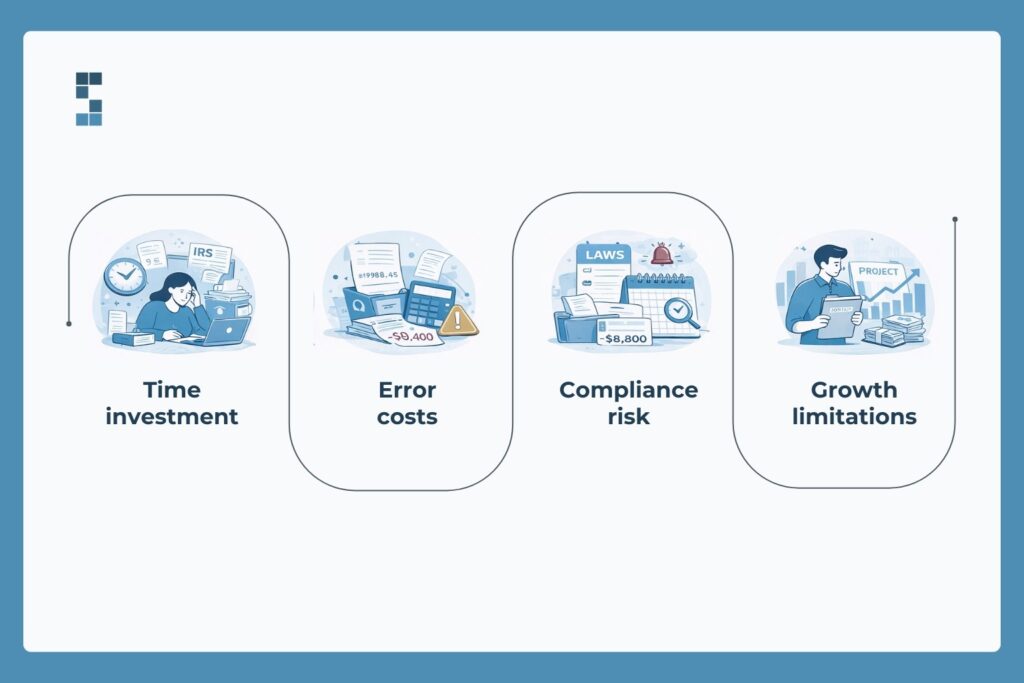
Let’s break down what DIY payroll actually costs you. Four categories that most business owners miss entirely.
Time investment. We covered the basics above, but consider this: you’re not just processing payroll. You’re also handling new hire paperwork, termination documentation, benefits enrollment coordination, and fielding team questions about their paychecks. Every single pay period. It adds up to roughly 100 hours annually—equivalent to two and a half full work weeks you could spend on billable client work instead.
Error costs. This is where DIY payroll gets really expensive. IRS penalties for payroll tax mistakes average $845 per incident. State penalties stack on top. Incorrect withholding calculations require correction and often trigger additional penalties.
Here’s a real example: One System Six client discovered they’d been making a simple bookkeeping error that cost them $700 in unnecessary bank fees each month. That’s $8,400 annually from a single mistake they didn’t even know they were making. Another client brought on a freelance contractor to handle their books in 2014, and as Manish G. described it, “the job was just too much for this individual. Most of our payroll taxes were filed incorrectly, and there was no easy way for a non-expert to figure out how to solve that mess.”
When they let the contractor go, they had no one to process payroll, which put them “in a bind with our clients, vendors, and employees.” The cascade effect of payroll errors extends far beyond the immediate penalty—it damages relationships and creates operational chaos.
Compliance risk. Payroll tax regulations change constantly. Paid sick leave laws, minimum wage adjustments, and new reporting requirements—staying current requires ongoing attention. If you’re operating in multiple states (and most growing consulting firms are), you’re juggling different rules for each jurisdiction.
Miss a compliance deadline? You’re looking at automatic penalties plus interest. One consultant told us she nearly missed a major tax deadline because “nobody was properly tracking compliance requirements across their multi-state client base.” She caught it with three days to spare—pure luck, not system design.
Growth limitations. This might be the most expensive hidden cost of all. DIY payroll systems that work for five employees often can’t scale to fifteen. The complexity multiplies faster than most people expect.
We saw a strategy consulting firm pass on a $200,000 contract because their financial infrastructure couldn’t handle the project’s complexity. They needed detailed time tracking, milestone billing, and multi-phase budget management—and their current systems couldn’t deliver it. How do you calculate the cost of that missed opportunity? It’s not just the immediate $200,000 revenue loss. It’s the relationship, the referrals, the portfolio piece, and the team growth that the contract could have funded.
The Managed Service Investment
So what does professional payroll management actually cost—and what do you get?
For most consulting firms, managed payroll costs $400-800 per week, depending on team size and complexity. Let’s call it $600 per week, or $2,400 per month. That sounds like a lot compared to $50 DIY software, right?
But here’s what that investment includes: Multi-state payroll processing. All federal, state, and local tax filings. New hire onboarding paperwork. Termination documentation. Benefits administration coordination. Unlimited consultation when questions arise. Technology integration with your existing systems. And—this matters—an error guarantee.
Paul, who runs an investor-backed business, put it this way: “We just finished our 2022 audit, and the auditors found exactly zero errors by S6. Not only have they been mistake-free, but S6 has also been proactive at catching mistakes I’ve made or seeing challenges coming down the pike.”
Zero errors. In an entire year. Across hundreds of transactions.
Now let’s talk ROI. When you move to managed payroll, you reclaim fifteen to twenty hours monthly. At a $200 hourly billing rate, that’s $3,000-4,000 in recovered revenue potential. Every month. That’s $36,000-48,000 annually in time you can now spend on actual client work instead of tax forms.
Subtract your $2,400 monthly investment from your $3,000-$4,000 in reclaimed billable time. You’re coming out $600-1,600 ahead each month—before we even account for the errors you’re avoiding or the growth opportunities you can now pursue.
Betsy described the shift perfectly: “System Six has done wonders for my stress level to feel like this is all now taken care of with a professional partner.”
But what if you have a simple payroll? Just a few employees, straightforward salary structure, single state? Even “simple” payroll requires compliance with regulations, quarterly filings, year-end reconciliations, and new-hire paperwork. And here’s the thing about payroll—it never stays simple. You hire someone remote. You add a contractor. You expand to a new state. Suddenly, your “simple” payroll has sixteen different compliance requirements you need to track.
Making the Decision
Here’s how to figure out which approach makes the most financial sense for your specific situation.
Ask yourself these five questions:
- What’s your effective hourly rate for billable work?
- How many hours monthly do you currently spend on payroll (track it honestly for one month)?
- How confident are you in multi-state compliance as you grow?
- What’s the cost if you make a single mistake?
- What would you actually do with fifteen hours back each month?
Now do the real math. Multiply your hours by your hourly rate. Add your error risk (even one mistake annually averages $845). Factor in the growth opportunities you’re missing because you’re stuck in administrative tasks instead of business development.
Compare that total to your managed service investment.
Most consulting firms discover the managed approach pays for itself three to four times over. And that’s before accounting for peace of mind, which turns out to be worth more than most people expect.
What Your Business Could Look Like
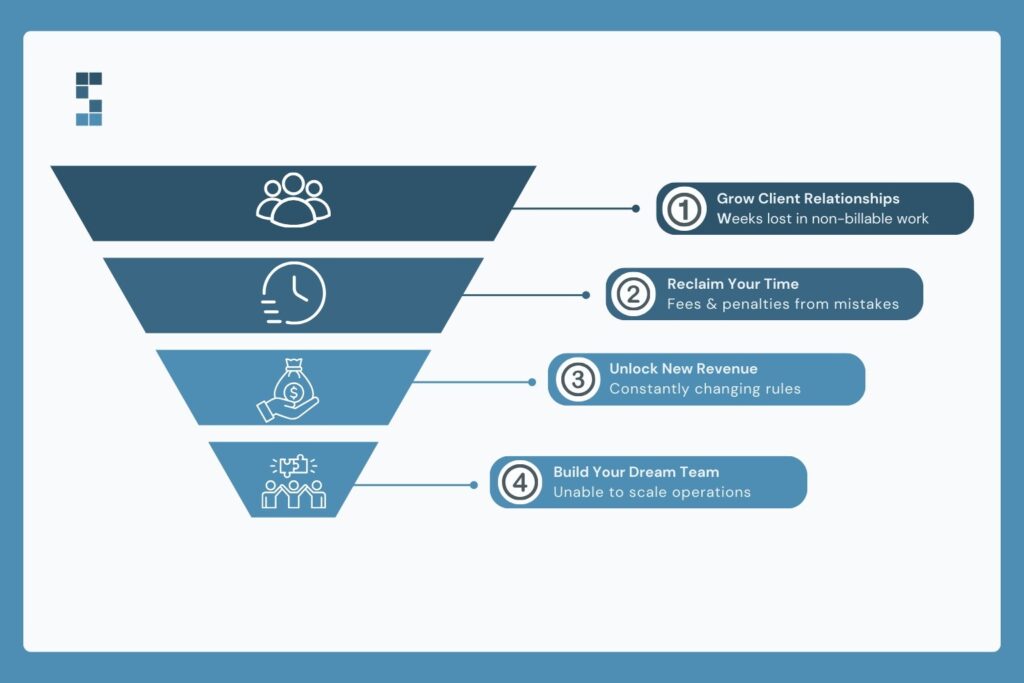
Marcus eventually switched to managed payroll. The decision cost him $650 monthly—but gave him back twelve hours, eliminated the 3 AM worry about whether he’d filed correctly, and freed him to take on two new clients he’d previously had to decline. His “savings” from DIY payroll had actually been costing him roughly $40,000 annually in lost opportunity.
The question isn’t whether you can do your own payroll. You’re intelligent, capable, and perfectly able to figure out tax forms. The question is whether you should, given what that choice costs you in time, risk, and opportunity.
Track your actual payroll hours for the next month. Include everything—data entry, research, troubleshooting, verification, and tax filing preparation. Calculate what those hours would be worth if you spent them on client work instead. Then ask yourself: Is DIY payroll actually the cost-effective choice?
What would your business look like if payroll were handled—correctly, completely, and automatically—while you focused on what you actually get paid to do?
About System Six
System Six is a Seattle-based bookkeeping and financial services firm that helps consulting firms streamline their financial operations. We specialise in providing technology-driven financial management solutions that enable owners to focus on growing their businesses without worrying about payroll, compliance, or cash flow. Our team of 35+ professionals brings an average of 10+ years of accounting experience to every client relationship, serving more than 175 businesses across the U.S. with a 9.5/10 NPS score. Learn more at www.systemsix.com.