Sarah stared at the proposal in front of her, calculator in hand. The automated cash flow system would cost her consulting firm $800 per month. That seemed like much money.
But then she started thinking about last month. She’d spent an entire Sunday reconciling accounts because three client payments got misallocated. Her project manager had wasted half a day tracking down expense receipts. And they’d nearly missed a tax deadline.
What Sarah was experiencing is the ROI confusion that costs businesses thousands in hidden expenses every year. She was focused on that $800 monthly fee while completely missing the expensive chaos her “free” system was creating.
Here’s what most business owners don’t realize: ROI isn’t just about what you spend. It’s about what you gain, what you save, and what you avoid losing. When you understand this distinction, the math becomes crystal clear.
The Real Cost of “Free”
Here’s the truth: your manual system isn’t free.
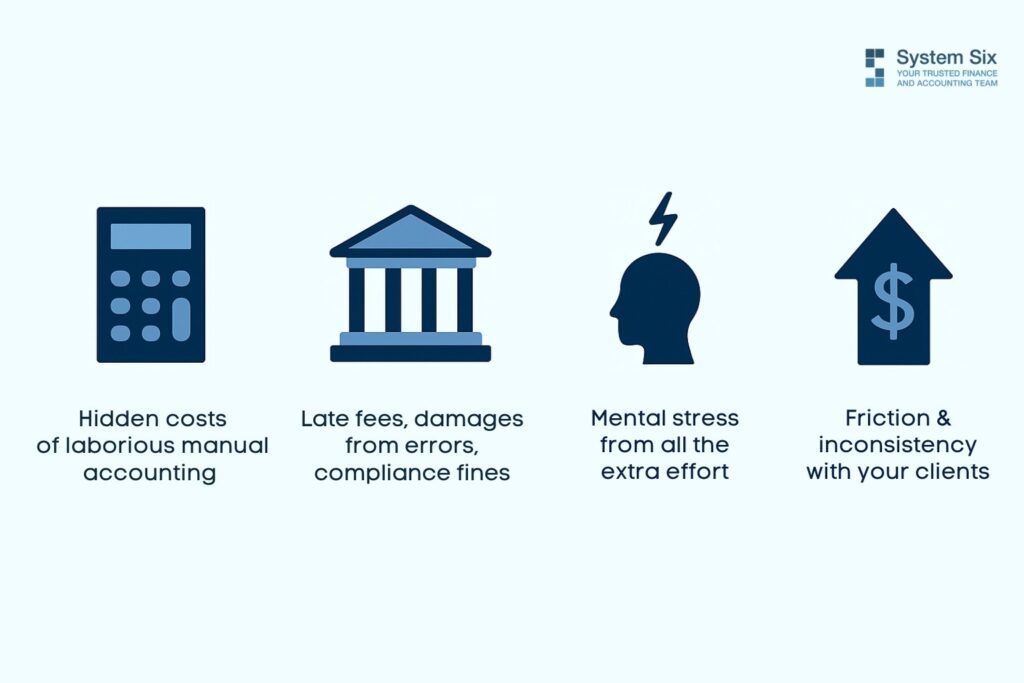
If you’re spending 15 hours monthly on financial tasks—invoicing, reconciling, tracking expenses, chasing payments—and your effective hourly rate is $200, you’re looking at $3,000 monthly in hidden costs. That’s $36,000 annually, just in your time.
But it gets worse.
One business owner discovered he was paying $700 in unnecessary bank fees each month because poor cash flow tracking led him to trigger overdraft fees repeatedly. That’s $8,400 annually—enough to pay for sophisticated tools and still come out ahead.
Then there are the error costs. Late payment penalties. Compliance fines. Client relationships were damaged due to inconsistent billing. These aren’t theoretical—they’re real money walking out your door.
And we haven’t even touched on the mental load. Those Sunday nights reconciling accounts. The background anxiety about whether you’re missing something. The constant switching between “business owner” mode and “amateur accountant” mode.
Your “free” system often costs three to five times as much as professional solutions. You can’t see it on your bank statement.
The Three-Part ROI Framework
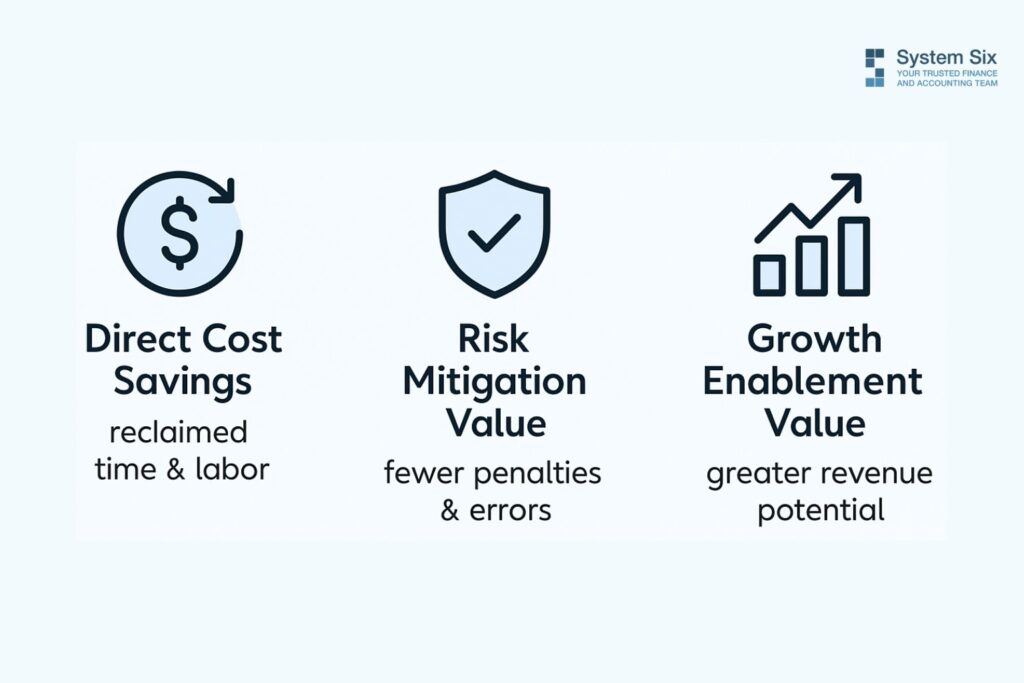
ROI isn’t just what you spend. It’s what you gain, save, and avoid losing.
Part 1: Direct Cost Savings
This is time and labor you get back. Mark runs an environmental consulting firm. Before automation, he spent 12-15 hours weekly on financial tasks. After implementing automated transaction categorization and real-time dashboards, he reclaimed 10+ hours every week.
His firm grew 40% the following year while maintaining the exact administrative headcount.
“Working with System Six to automate our finances changed everything,” Mark shares. “Now I can pull up real-time insights from my phone between client meetings. We’ve grown significantly because I can focus on clients instead of paperwork.”
Part 2: Risk Mitigation Value
What do you save by avoiding penalties, errors, and missed opportunities? Automated systems catch things you’d forget. They track compliance deadlines systematically. They reconcile accounts daily rather than monthly, catching mistakes when they’re minor rather than catastrophic.
“System Six has done wonders for my stress level,” one client told us. “They’ve created automated systems that track every deadline and requirement. I no longer worry about compliance—it’s all handled automatically.”
No more late fees. No more scrambling at tax time. No more discovering errors three months after they happened.
Part 3: Growth Enablement Value
This is the big one. Better financial systems don’t just improve efficiency—they unlock revenue opportunities.
Elena runs a 12-person strategy consulting practice. Before automation, the month-end close took 5-7 days, and financial reports were perpetually outdated. After implementing full automation, the month-end dropped to less than a day.
But the real magic? Elena’s team gained clear visibility into project profitability, leading to a 22% increase in average project margin. Cash flow forecasting improved, allowing strategic hiring ahead of demand.
“The clarity we gained gave us the confidence to open a second office and hire three new consultants,” Elena reports. “We knew exactly which project types to pursue and had the cash flow visibility to make these moves confidently.”
One extra client meeting per week, enabled by automation, can translate into tens of thousands of dollars in additional annual revenue.
Your DIY ROI Worksheet
Let’s make this real. Grab a calculator.
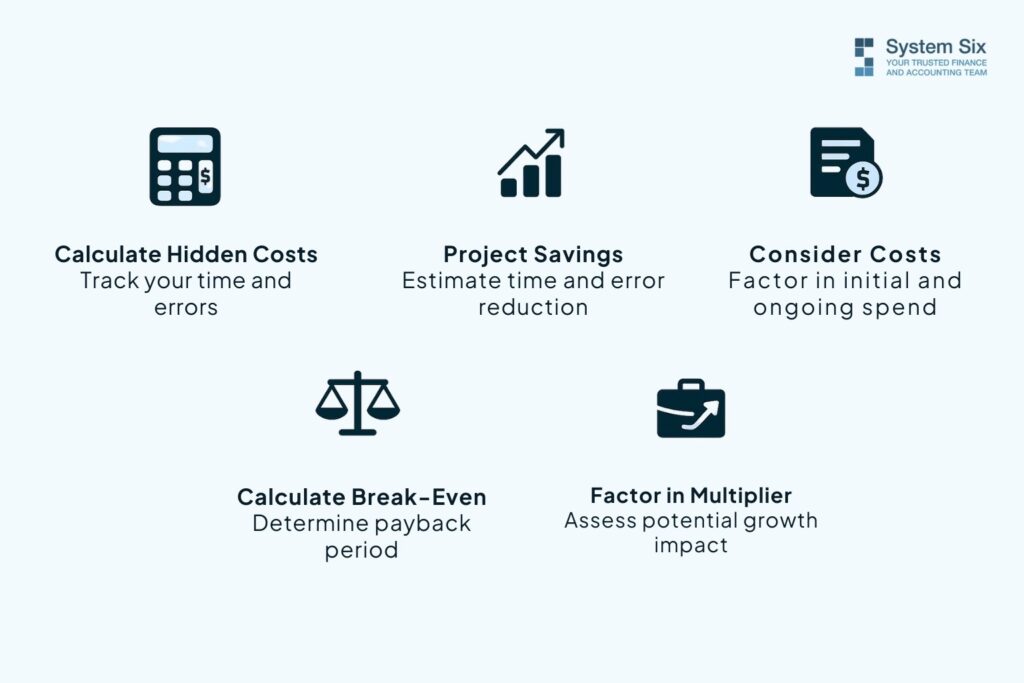
Step 1: Calculate Your Current Hidden Costs
Track your time for one week. How many hours are you spending on financial tasks? Multiply that by four to get monthly hours. Then multiply by your effective hourly rate.
Example: 4 hours weekly × 4 weeks = 16 hours monthly × $200/hour = $3,200 in opportunity cost.
Now add up recent error costs from the last three months. Bank fees. Late penalties. That invoice you forgot to send. Divide by three for your monthly average.
Step 2: Project Your Savings
Automation typically reduces time spent on financial tasks by 70-80%. So if you’re spending 16 hours monthly now, you’d drop to about 3-4 hours, mostly reviewing automated reports.
You’d save 12 hours monthly. At $200/hour, that’s $2,400 in reclaimed time.
Most businesses see errors drop 80-90% with automation. If you’re averaging $500 in monthly error costs, reduce them to under $100.
Cash flow improvement? Automated invoicing typically reduces average payment time by 15-25 days. If you’re carrying $50,000 in receivables and your cost of capital is 6%, shaving 20 days off payment time saves roughly $165 monthly.
Step 3: Consider Costs
Setup typically ranges from a few hundred to a couple of thousand dollars. Monthly costs for automation tools and services usually range from $400 to $800 for small- to mid-sized businesses, covering bookkeeping, automation, reporting, and advisory support.
Step 4: Calculate Break-Even
Simple formula: Total One-Time Investment ÷ Monthly Net Savings = Months to Payback.
Real numbers: Say you invest $2,000 in setup and pay $800 monthly. Your monthly savings total $2,900 ($2,400 in time + $400 in error reduction + $165 in cash flow improvement minus $800 in fees = $2,165 net monthly benefit).
Your one-time costs pay back in less than one month. After that, you’re $2,165 ahead every single month.
Industry benchmark? Most firms hit break-even within 2-3 months.
Step 5: Factor in the Multiplier
What could you do with 12-15 extra hours monthly? Land one additional client quarterly? That could represent $50,000 to $100,000 in annual revenue growth.
As one business owner told us: “We’ve grown 40% this year because I can focus on clients instead of paperwork.”
Real Numbers from Real Businesses
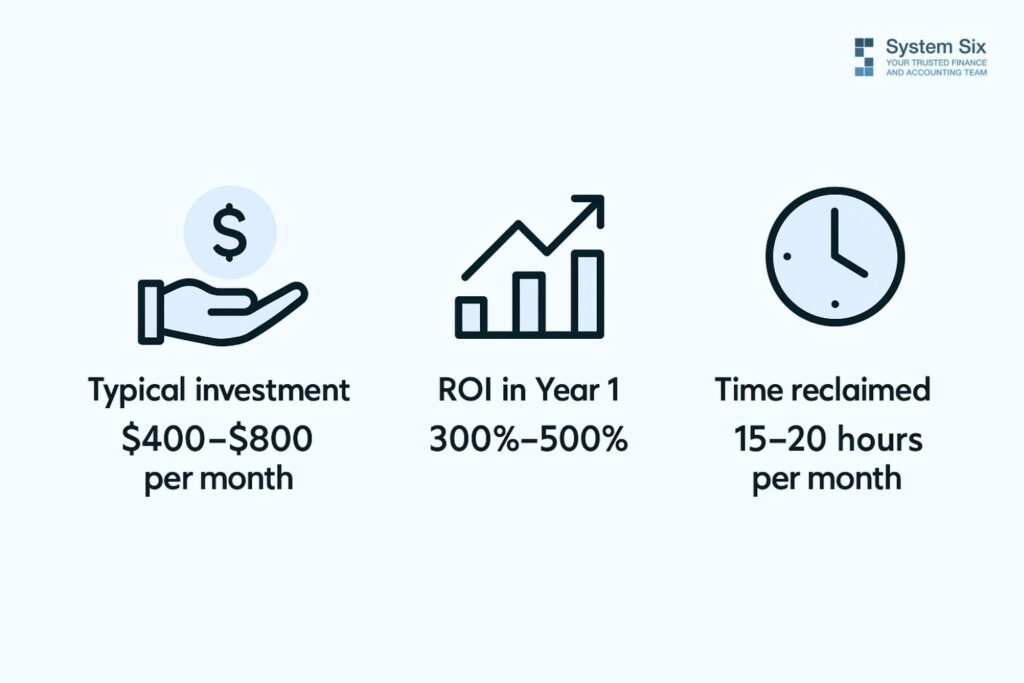
Typical investment runs $400-$800 per week. Expected first-year ROI? Most businesses see returns of 300-500% through reclaimed time, improved efficiency, better decision-making, reduced compliance costs, and accelerated growth.
Payback period averages 2-3 months. Time reclaimed typically runs 15-20 hours per month.
Elena’s strategy firm went from struggling with a 5-7 day month-end close to opening a second office. The financial clarity didn’t just improve operations—it enabled growth that wouldn’t have been possible before.
The investment becomes self-sustaining within months, then generates profits for years.
The Decision Framework
Still on the fence?
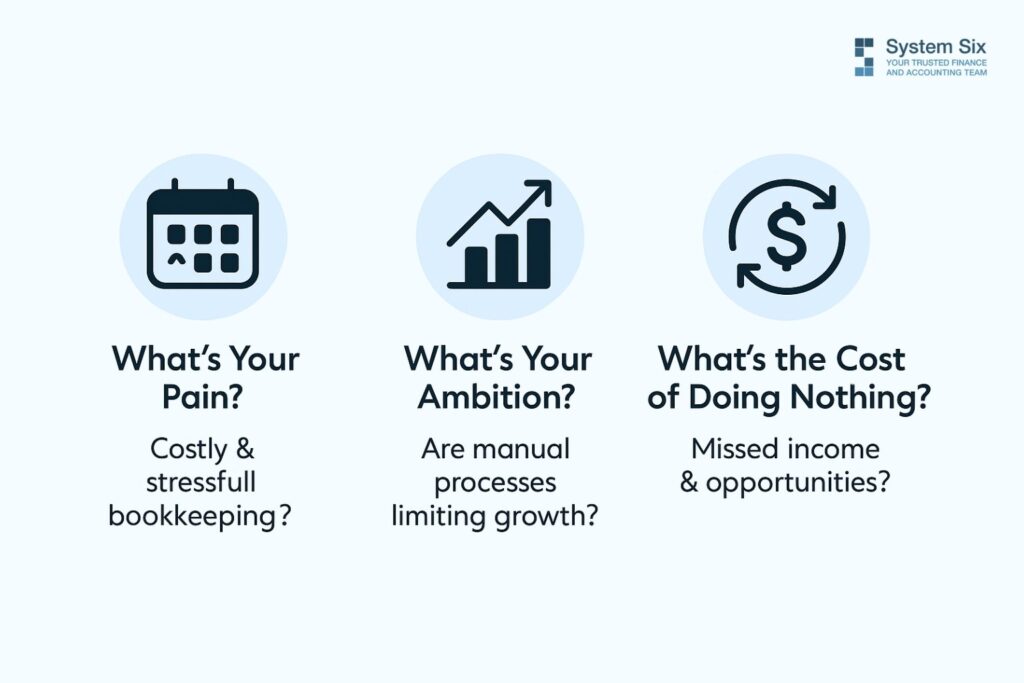
What’s your current pain level? If you’re spending Sundays on bookkeeping and stressed about missed deadlines—that’s a signal. Your manual system is costing you more than money.
What’s your growth ambition? You can’t scale on manual systems. At some point, administrative burden becomes a constraint on growth.
What’s the cost of inaction? Every month you delay, you miss strategic opportunities. That $3,000 monthly in wasted time? That’s $36,000 in annual income you’re leaving on the table.
The question isn’t whether you can afford to automate. It’s whether you can afford not to.
Your Next Move
You didn’t become a business owner to spend weekends wrestling with reconciliations. You started your business to solve problems, serve clients, and build something meaningful.
Automation doesn’t just save time and money. It gives you back your weekends and lets you focus on what you do best.
What would you do with an extra 15-20 hours each month? Successful business owners already know the answer. They’d grow their business.
Start simple. Track your time for one week. Write down every hour you spend on financial tasks. Calculate what those hours cost. Add up recent error costs. Look at the total.
The numbers will speak for themselves.
About System Six
System Six is a Seattle-based bookkeeping and financial services firm that helps small and mid-sized businesses streamline their financial operations. We specialize in providing technology-driven financial management solutions for consulting firms, allowing owners to focus on growing their businesses without worrying about cash flow, payroll, or compliance issues. Our team of over 35 professionals brings an average of 10+ years of accounting experience to every client relationship, serving more than 175 businesses across the U.S. From accurate bookkeeping to cash flow forecasting, we deliver the financial clarity and peace of mind that consulting firm owners need to thrive. Learn more at www.systemsix.com.